
Do Brain Games Actually Improve Memory? Here's What the Research Says
If you've typed "do brain games improve memory" into a search bar, you've probably run into two extremes: breathless claims that a 2-minute daily game will out-smart aging, and cynical takes dismissing the entire category as snake oil. Neither one holds up.
We run Mega Brain Puzzle, so we've watched how people actually play these games across thousands of quiz and memory-game sessions — not just read the studies about them. What follows is the honest middle ground: what brain games can realistically do for your memory, what they can't, and how to actually get a benefit instead of just a high score.
What "Brain Training" Actually Means (And What It Doesn't)
"Memory" isn't one skill — it's several, and most brain games only touch one or two of them at a time. That distinction matters more than which app or site you use.
- Working memory — holding a few items in mind while you use them (a memory-matching card game trains this directly).
- Processing speed — how fast you recognize and respond to information (timed trivia and word-scramble games train this).
- Pattern recognition — spotting structure or repetition (sudoku and pattern-matching puzzles train this).
- Recall / retrieval — pulling a specific fact back out of long-term memory (trivia questions train this one specifically).
A game that's great for processing speed won't necessarily do anything for long-term recall. That's the first thing most "brain training" marketing glosses over.
What the Science Actually Shows
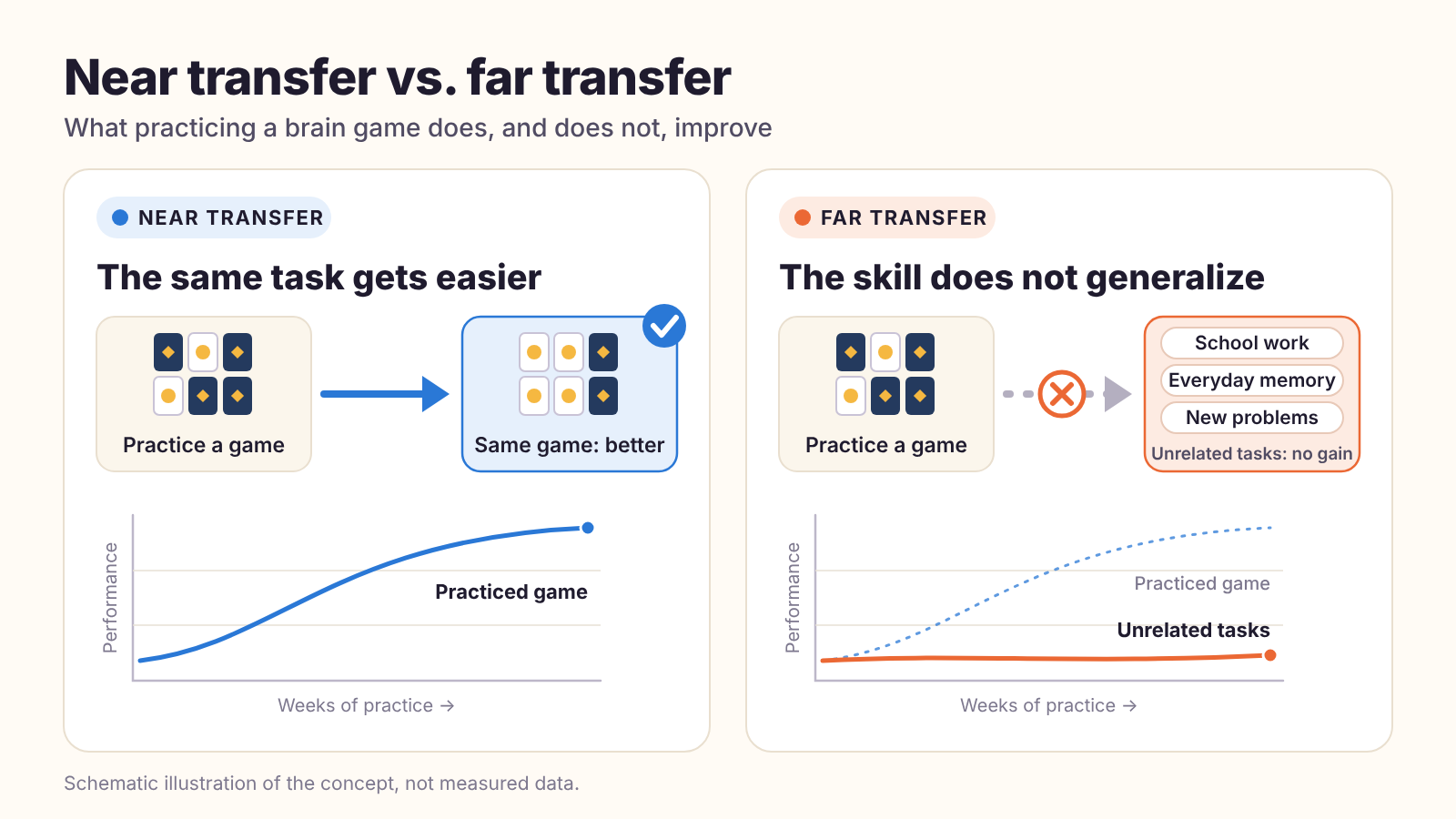
A widely cited 2010 study published in Nature (Owen et al., often summarized as the "Putting Brain Training to the Test" study) had thousands of participants complete six weeks of online brain training. The result: people got measurably better at the specific trained tasks, but that improvement barely spilled over into general cognitive ability. That's the finding almost every brain-training skeptic points to, and it's a fair one.
The "Near Transfer" Effect — You Get Better at What You Practice
This part is well established and not controversial: practice a specific type of memory task regularly, and you get faster and more accurate at that specific task. Play enough memory-matching games and your matching speed improves. That's real, it's measurable, and it's the main thing brain games reliably deliver.
The "Far Transfer" Myth — Why It Doesn't Make You Smarter Overall
What's far less supported is the claim that this improvement generalizes into "better memory" or "higher IQ" across unrelated areas of life. The large trials — including the well-known ACTIVE cognitive training study in older adults — found training benefits stayed closely tied to the trained task rather than transforming overall cognition.
A Red Flag Worth Knowing: "Clinically Proven" Claims
If a brain-training product claims it's "clinically proven" to boost IQ, reverse cognitive decline, or prevent dementia, that's worth real skepticism. The U.S. Federal Trade Commission fined the brain-training company Lumosity $2 million in 2016 for exactly this kind of overstated marketing — claiming the app could reduce cognitive impairment from conditions like Alzheimer's without evidence strong enough to back it up.
That doesn't mean the games are worthless — it means the honest pitch is narrower: expect sharper performance on tasks similar to what you practice, not a general intelligence upgrade.
What We've Noticed From Watching Real Play Sessions
Beyond the research, we see patterns in how people actually use trivia and memory games day to day. A few things stand out consistently, and they line up with what the near-transfer research predicts.
- Players who return to the same trivia category over several sessions get noticeably faster at recognizing question patterns within that category — classic near-transfer, not general intelligence.
- People who mix categories (history one day, science the next, pop culture after that) report the games staying interesting far longer than people who repeat one category on autopilot.
- Short, frequent sessions (5–10 minutes most days) seem to stick as a habit far better than long, occasional sessions — which also matches sleep and spaced-repetition research on memory consolidation.
Trivia vs. Pattern Games — Different Benefits
Trivia questions specifically exercise retrieval — pulling a fact back out of storage, which is the memory skill people usually mean when they say they're "getting forgetful." Pattern and logic games like sudoku train something closer to working memory and reasoning. If your goal is "remember things better," trivia-style recall practice is the closer match.
How to Actually Get a Benefit From Brain Games
Given what the research supports, here's what we'd actually recommend if the goal is a real cognitive benefit rather than just entertainment.
Consistency Beats Intensity
A daily 5-minute session builds more durable improvement than an occasional hour-long binge. This matches what's known about spaced repetition strengthening memory more effectively than cramming.
Mix Categories, Don't Just Repeat Your Favorite
Since benefits transfer mainly to similar tasks, rotating through different question types and game formats gives you broader near-transfer coverage than mastering just one.
Pair It With Real-World Habits
Sleep, physical activity, and social interaction have stronger, better-documented effects on memory than any training app. Brain games work best as one piece of that picture, not a replacement for it.
- Play for 5–10 minutes rather than 45 minutes once a week.
- Rotate between trivia, memory matching, and a logic game like sudoku across the week.
- Treat it as a mental warm-up, not a substitute for sleep or exercise.
- If you're studying for something specific, practice recall of that actual material — generic trivia won't transfer to an exam the way reviewing your own notes will.
Who Actually Benefits Most From This
Not everyone is starting from the same place, and the realistic benefit looks a little different depending on why you're playing.
- Older adults wanting to stay mentally active — near-transfer gains plus the social and routine-building benefits of a daily habit are both real and worthwhile, even without a far-transfer "cure."
- Students building general knowledge — trivia-style recall practice genuinely strengthens retrieval, which is useful groundwork for any subject that rewards knowing facts cold.
- Anyone rebuilding focus after a screen-heavy stretch — short, structured games are a low-stakes way to practice sustained attention in 5-minute blocks.
- Caregivers looking for a shared activity — memory games built for two players give you a genuine social activity, not just a solo screen habit, which matters since social engagement has its own independent link to cognitive health.
Our Recommendation: Which Games to Start With
If you want to build a simple weekly rotation based on what the research above actually supports, this is the mix we'd suggest:
- Recall practice: a themed trivia quiz like our General Knowledge quiz.
- Working memory: a themed memory card game to build matching speed.
- Pattern and logic: a daily Sudoku puzzle for structured reasoning practice.
- Processing speed: a quick Word Search for scanning and recognition.
Bottom Line
Brain games won't make you generally smarter, but they reliably sharpen the specific skills you practice — and recall-based games like trivia are the closest match if memory is your actual goal. Build a short, consistent, mixed rotation instead of chasing a single magic app.
Put This Into Practice
Frequently Asked Questions
Do brain games really improve memory, or is it a myth?
How often should I play brain games to see a difference?
What's the best brain game for memory specifically?
More From the Blog
Free Printable Trivia for Classrooms: A Teacher's Guide by Grade Level
After watching how teachers actually use printable trivia sheets, here's what works by grade level — and the formats worth stealing.
How to Host a Trivia Night People Actually Want to Come Back To
We've pulled question sets for enough home and pub-style trivia nights to notice a pattern: the ones people talk about afterward follow the same handful of rules.
Screen Time You Don't Have to Feel Guilty About: Picking Educational Games for Kids
Not all screen time is equal. Here's how to tell an educational game from a time-filler, and which formats are actually worth your kid's attention by age.