
Free Printable Trivia for Classrooms: A Teacher's Guide by Grade Level
Printable trivia shows up in classrooms more than almost any other free resource teachers download, and for a simple reason: it needs no devices, no login, and no WiFi that might drop halfway through class.
We publish free printable trivia sheets, and the feedback we hear most from teachers isn't "where do I find trivia" — it's "how do I pick the right questions for my grade level and actually run this well in 10 minutes." That's what this guide covers.
Why Printable Trivia Still Works in a Digital Classroom
Most classroom tech tools assume every student has a working device, a charged battery, and a stable connection on the day you need them. Paper doesn't have any of those failure points.
- No login screens, no app installs, no "it won't load" five minutes into class.
- Works instantly for a sub who has never used your classroom tech stack.
- Doubles as a quiet, screen-free activity for early finishers or transition time.
- Scores and participation are visible on paper — useful for quick formative checks without a gradebook app.
Matching Trivia to Grade Level (This Is Where Most Printables Fail)
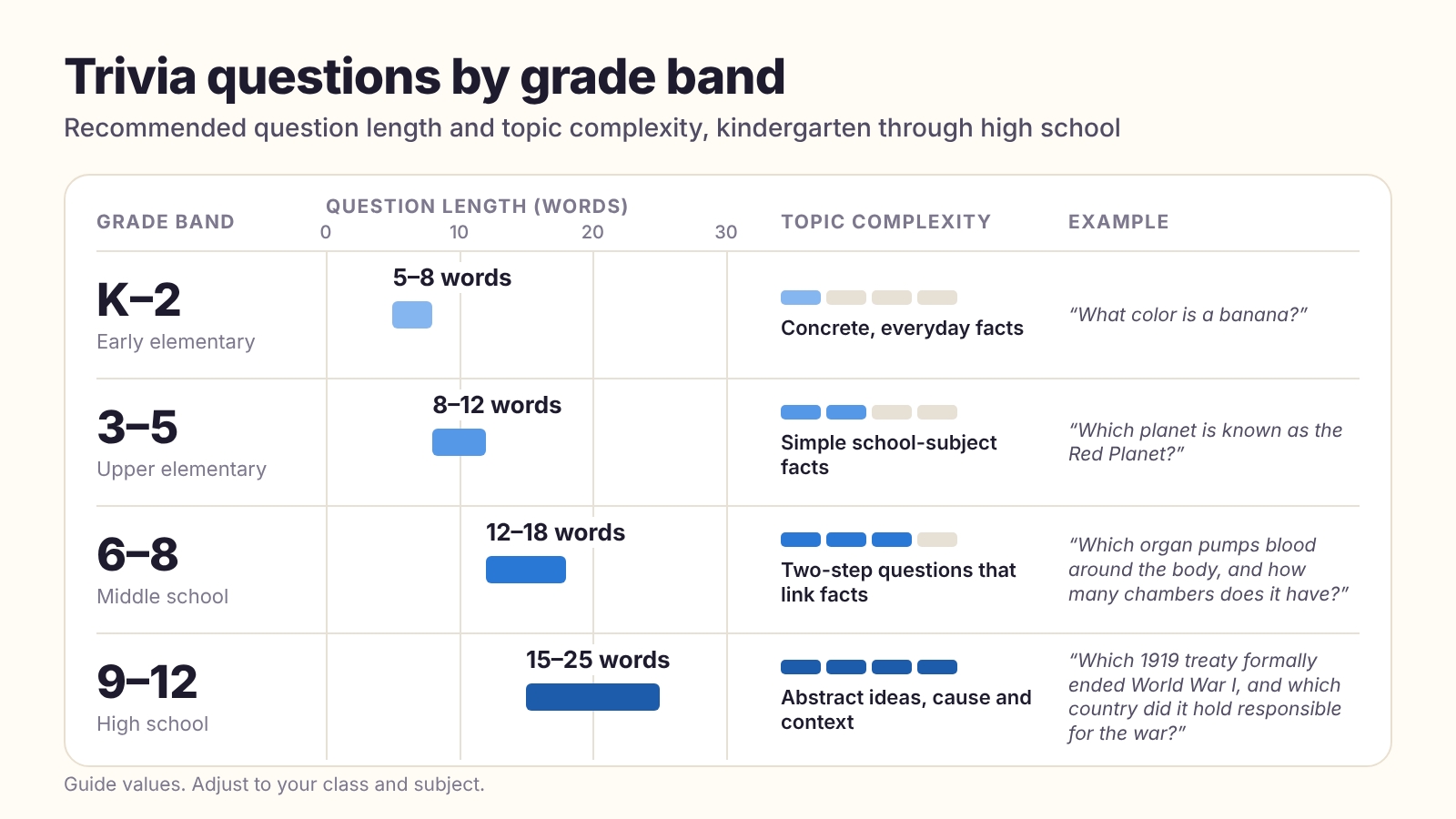
A sheet of generic trivia questions dropped into a 2nd-grade classroom and a 10th-grade classroom will land completely differently. The question isn't just difficulty — it's format.
Grades K–2: Keep It Visual and Short
At this age, reading the question is half the challenge. Favor simple, concrete facts (animals, colors, shapes, basic science) over abstract or multi-step questions, and keep each sheet to 5–8 questions max.
Reading the question aloud yourself, rather than expecting independent reading, keeps this age group from checking out halfway through. Kids-focused categories work better here than anything pulled from a general adult-trivia set.
Grades 3–5: Build General Knowledge
This is the sweet spot for broad general-knowledge trivia — geography, animals, basic history, and science facts kids are starting to connect across subjects. 10–12 questions works well for a full activity block.
This is also the age where kids start caring about keeping score, so a simple visible point tally (even just tally marks on the board) adds motivation without needing a full scoring system.
Grades 6–8: Add Difficulty and Team Formats
Middle schoolers respond well to competition. This is where team-based formats start to outperform solo worksheets, and where you can mix in harder, multi-part questions without losing the room.
This age group can also handle a wrong-answer penalty or a wager round without it derailing the activity — something that tends to frustrate younger students instead of motivating them.
High School: Use Trivia as a Review Tool, Not Just a Game
By high school, trivia works best tied directly to curriculum — a review round built from the unit you just taught lands better than generic pop trivia, which can feel like filler to older students.
Framing it explicitly as exam prep ("last chance to catch a weak spot before Friday's test") gets more buy-in at this age than framing it as just a game.
5 Classroom Formats That Actually Work
The questions matter less than the format you run them in. These five come up again and again in how teachers actually use printable trivia.
- Bell-Ringer Trivia — 3–5 questions on the board or a half-sheet as students settle in; graded only for participation.
- Team Relay Trivia — split the class into teams, one runner per team brings answers to the front; built-in movement break.
- Sub-Day Packet — a self-contained sheet with questions and an answer key, so a substitute needs zero prep.
- End-of-Unit Review Trivia — questions pulled directly from what you just taught, framed as a game instead of a quiz.
- Trivia Bingo — call out trivia questions instead of numbers; first to get the answers in a row wins.
Common Mistakes Teachers Make With Classroom Trivia
A few patterns show up often enough in classroom trivia activities that they're worth naming directly, since each one is an easy fix once you notice it.
- Using one sheet for the whole range of ability levels in the room — mixing in 2–3 harder "bonus" questions lets advanced students stay engaged without alienating everyone else.
- Making every question worth the same regardless of difficulty, which can make an easy sheet feel pointless to stronger students and a hard sheet feel punishing to others.
- Running trivia with no time limit — without a visible timer, one or two questions can quietly eat the whole activity block.
- Treating trivia purely as filler instead of tying at least one round to what you're actually teaching, which is where most of the retention benefit comes from.
How Long Should a Classroom Trivia Activity Take?
This depends entirely on the format, and mismatched timing is one of the fastest ways an activity falls apart mid-class.
- Bell-ringer trivia: 3–5 minutes, 3–5 questions, no scoring needed.
- Team relay trivia: 10–15 minutes for a full 10-question round with the physical relay built in.
- Sub-day packet: self-paced, typically fills 20–30 minutes independently.
- End-of-unit review trivia: 15–20 minutes for 10–15 questions plus discussion of answers.
- Trivia bingo: 15–20 minutes depending on how many questions it takes to get a bingo.
How to Pick Questions That Match What You're Teaching
Rather than one giant mixed sheet, it's usually faster to pull from a category that matches your subject and print just that set. A few starting points by subject:
- Social studies / history → our US History and World History trivia
- Science units → our Science trivia category
- Geography → our World Geography trivia
- General review / icebreakers → our General Knowledge trivia
Each category page also breaks questions down by difficulty, so you can pull just the easy set for a warm-up or the hard set for an end-of-unit challenge without re-sorting questions yourself.
Printing Tips That Save You Time
A few small habits make reusing these sheets far less work the second and third time around.
- Print the answer key on the back of the last page instead of a separate sheet — one less thing to lose.
- Laminate a class set once and hand out dry-erase markers instead of reprinting every time.
- Keep a labeled folder by subject so you're not re-searching the same category every week.
- Print double-sided by default — most sheets fit comfortably on one or two pages.
Bottom Line
Printable trivia works in almost any classroom because it has zero tech dependencies — the real lever is matching question style to grade level and picking a format (relay, bell-ringer, review round) that fits the ten minutes you actually have.
Put This Into Practice
Frequently Asked Questions
What age group is printable trivia best for?
Can I edit or customize these printable trivia questions?
Do I need an account to download printable trivia sheets?
More From the Blog
Do Brain Games Actually Improve Memory? Here's What the Research Says
Brain training apps promise sharper memory and a smarter you. Here's what the research actually supports — and what it doesn't.
How to Host a Trivia Night People Actually Want to Come Back To
We've pulled question sets for enough home and pub-style trivia nights to notice a pattern: the ones people talk about afterward follow the same handful of rules.
Screen Time You Don't Have to Feel Guilty About: Picking Educational Games for Kids
Not all screen time is equal. Here's how to tell an educational game from a time-filler, and which formats are actually worth your kid's attention by age.